Summer 2024 Newsletter
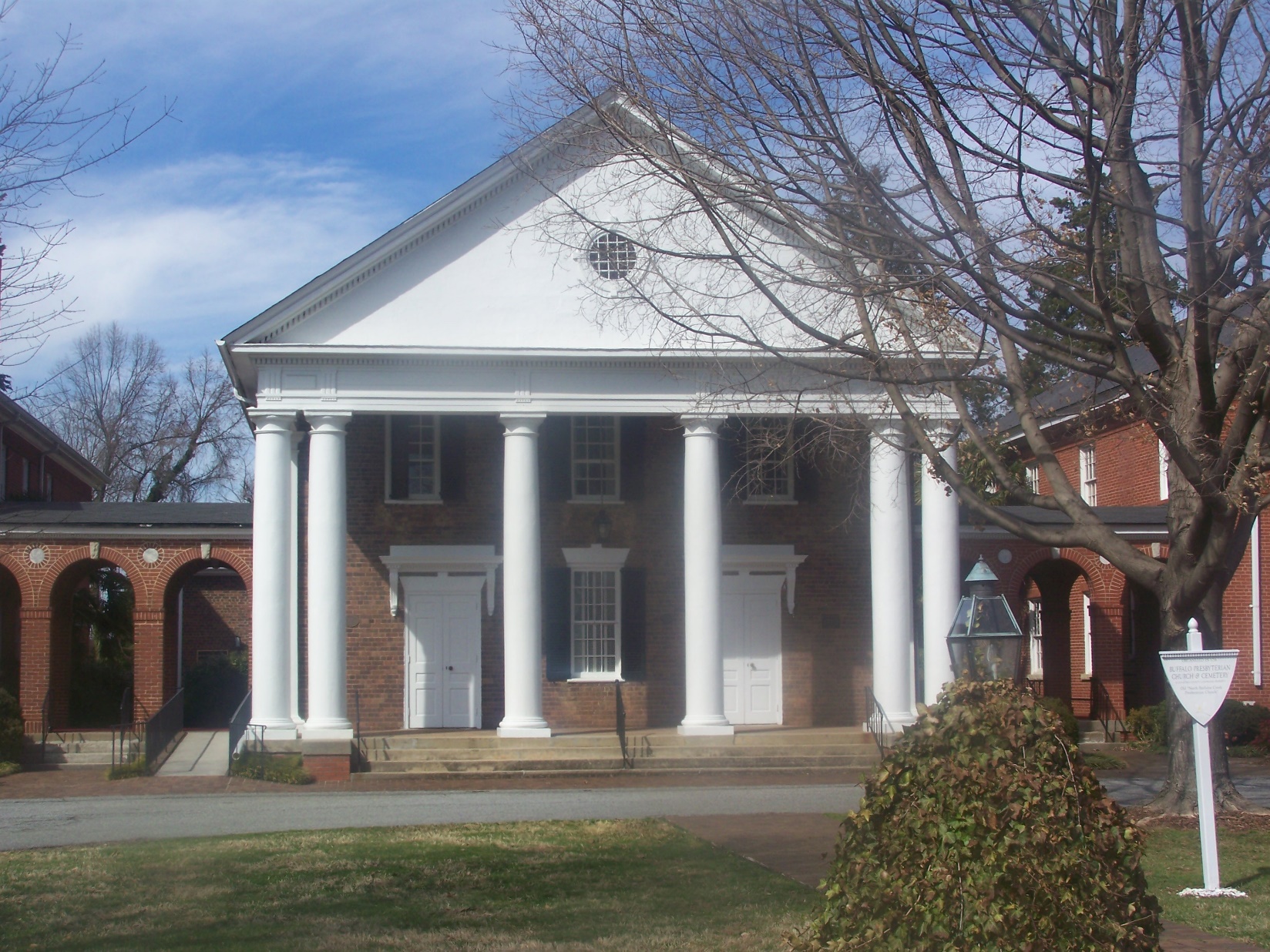
Buffalo Presbyterian Church and David Caldwell

Buffalo Presbyterian Church (Photo by Sam Martin)
Buffalo Presbyterian Church was founded in 1756, a short time before the founding of Greensboro and the establishment of our state and nation. David Caldwell, an important educator and politician, was the first minister of Buffalo and served for 55 years. Caldwell was also the first minister at nearby Alamance Presbyterian Church which was founded in 1764. Buffalo was an old side congregation while Alamance was a new side one. There were no doctrinal arguments, but the Alamance church adopted a new more enthusiastic worship style influenced by the “awakenings” occurring nationally. Caldwell did not see this as a religious problem. Rev. Caldwell is buried in the Buffalo cemetery.
Presbyterian Log Colleges and the New Republic
In the American Revolution period there were less than 10 universities in the 13 states and none in NC. A crucial development was the creation of Presbyterian affiliated academies and so-called log colleges. After two years in a classic academy or log college an aspiring graduate could apprentice to become a lawyer or physician or enter the third year of a university. The log college alone was sufficient to produce many congressmen, senators, governors, preachers and military officers. There were several early important Presbyterian academies in the development of NC culture.
Queen’s College, founded 1770 in Charlotte by the General Assembly, was the first NC institution of higher learning. It was ratified by Gov. Tryon but rejected by the Crown because too many non-Anglican dissenters (Presbyterians) were trustees. The college operated for a couple of years with name changes to Queen’s Museum and later Liberty Hall. After the Revolution it was closed and resurfaced as Salisbury Academy under Samuel McCorkle. This academy closed in 1791 and McCorkle and his congregation at Thyatira started Zion-Parnassus Academy. McCorkle was one of 23 Princeton graduates trained under John Witherspoon who became Presbyterian ministers or educators in NC. Other early academies were Clio’s Nursery near Statesville and Crowfield Academy in Iredell County. Crowfield operated from 1760 to 1788. Many education and political leaders were graduates, and it is stated Crowfield was the impetus behind Davidson College founded in 1837.
David Caldwell D.D. and the Greensboro Log College
David Caldwell, a Princeton graduate, was an educator, minister, physician, farmer and astute politician. He was deemed the most important educator, during the revolutionary period, south of the Potomac river. He, his wife Rachel Craighead and his congregations at Buffalo and Alamance were of Ulster Scot (Scots-Irish) descent and fervent patriots for the American cause. Caldwell had about 50 students annually and educated 33 other log cabin academy presidents, 135 ministers, 50 U.S. and NC senators, six governors and many who went on to be physicians, lawyers and useful citizens. From the pulpit he preached that the Glorious Revolution in England, which gruesomely deposed King Charles, was justification for the American Revolution.
Carole Troxler
Dr. Carole Troxler has a PhD in history from UNC Chapel Hill and is a widely published expert on the Regulator War in NC. She is Professor Emeritus at Elon University.
Spring 2024 Tour: Scotland, Hoke, and Robeson Counties
The annual spring meeting of the Historical Society Meeting convened at Antioch Presbyterian Church in Red Springs, NC on April 5, 2024. Antioch Presbyterian Church is considered to be the continuation of Old Raft Swamp Church (1789), which was the first Presbyterian Church in the area. It still has artifacts, such as pewter communion plates from the original church. At first there were two services, one in English and one in Gaelic. Sam Martin presented the Dudley book to the church.
We continued our church visits at Philadelphus Presbyterian Church in Red Springs. Started by Scottish Highlanders in the 1700’s, the church was built in the 1860’s by a Negro carpenter. Members spoke English and Gaelic, and women and men sat separately in the church. There was an academy next door.
Our next visit was to Centre Presbyterian Church in Maxton, NC. Centre was originally the home of Floral College, the earliest college for women in North Carolina. This church, too, was built by a free black contractor, who built several other churches in the area. As with other churches of the era, Negroes were seated in the balcony.
On April 6, the “Day of the Tartan,” according to Don McLeod, we started the day visiting Old Laurel Hill Church in Laurinburg. We were welcomed by Neil McKey, the pastor, who led us in prayer. The Society of Friends had move to Scotland County, but in the 1760’s there was influx of Scots and English. In 1827, the last Quaker moved to Guilford or Orange County because of the slavery in the southern area of North Carolina. Here, too, preaching was in Gaelic and English. The church was started by three elders in 1797, and the preacher was shared by Centre Church 15 miles away on horseback. In 1853, the new church was built, again by the Negro contractor, Jackson Graham, and his crew. The old church was moved and became a school, which Sherman and his men ruined it and left graffiti all over it.
Old Laurel Hill Church suffered through the Depression and a wet spring that prevented the planting of crops by the farmer members of the church. The Rev. G. F. Kirkpatrick, minister at the time, asked members to set aside “God’s Acre,” where the crops would be their gifts to the church. In August 1931, members cooked and served dinner for the congregation and friends and neighbors who were invited to join them after worship. The visitors purchased goods and “even bought livestock and bales of cotton before returning home.” The “gathering” saved the church.
Rev. Dr. Douglas Kelly, our last speaker of the morning, spoke on “The Presbyterian Church during the Civil War.” While Virginia and South Carolina were Episcopalian States during this time, North Carolina was Presbyterian. Gov. Gabriel Johnson invited Highland settlers to reside here. Until the 19th century, Presbyterians dominated, but Methodists and Baptists began to gain a presence because they didn’t have to have an educated clergy. Presbyterians continued to be the dominant faith among intellectual leaders. The church did not call for revolt; politics was not to be the program of the church. There were many revivals during the War Between the States, especially in the army. (See Ben Lacy’s book Revival in the Midst of Years.) During the war there were many black members of the Presbyterian Churches, and many stayed after the war. The separation of blacks and whites in the church seats began in 1890; prior to this blacks sat with the families where they worked. White Men and women were also seated separately. Three black churches formed out of Old Laurel Hill Church, and they still exist, although one is now Methodist.
Our weekend ended with lunch and the business meeting.