Summer 2020 Newsletter
Historic Churches in Granville and Vance Counties
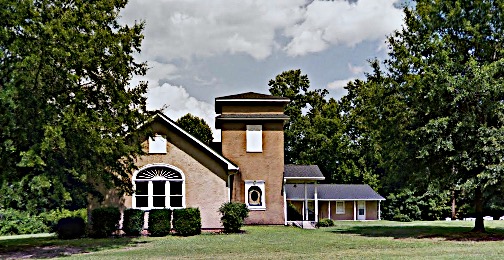
Geneva Presbyterian Church
Many Presbyterians are not aware that this area of northeastern North Carolina was one of the first regions settled by Scotch-Irish Presbyterians coming down from Pennsylvania through Virginia. They were encouraged to move into the area by land speculators from Ulster in the north of Ireland who had been granted a huge tract of land south of the Virginia border in 1737, with the stipulation that they bring in settlers. So why did the Scotch-Irish begin arriving in Granville? It all had to do with the roads.
The first road linking major towns in the colonies was sometimes known as the King’s Highway, though most of it was a postal trail for horse riders. Travel by water was much safer and easier. However, by 1750, it was possible to take stage coaches and wagons from Boston to Charleston, via Halifax, New Bern, and Wilmington. By 1735 the Fall Line Road forked inland at Fredericksburg, going through Richmond, Petersburg, Warrenton, Franklin and Wake counties, to Fayetteville, Scotland County, and S.C.
In the 1740s another road was cut going further inland from Fredericksburg, and by 1748 it could qualify as a wagon road. Known as the Upper Road or the Piedmont Road, it passed through Amelia Court House in Virginia and then came into N.C. at what was then Granville County. From there it passed through Orange, Alamance, Randolph, Davidson, Rowan, Cabarrus, Mecklenburg, and Gaston counties on its way eventually to S.C. and Ga. It was this road that was used by many Scotch-Irish travelling from Philadelphia south into eastern Virginia and then, as the way opened, into N.C. in the 1740s.
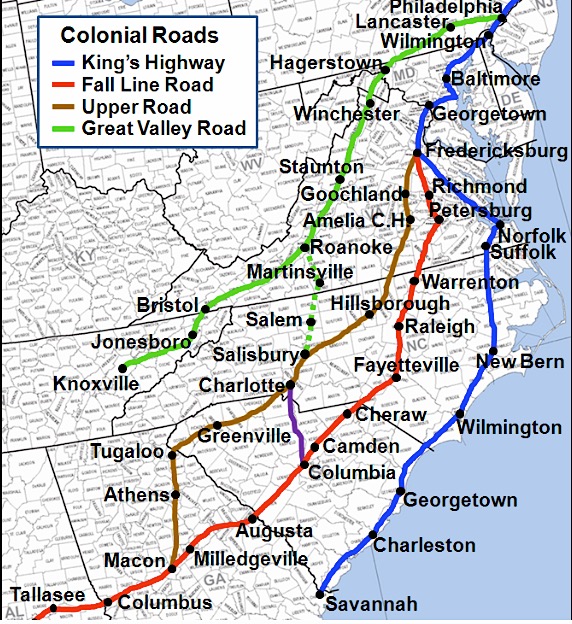
Colonial Roads Map (www.familysearch.org/wiki/en/Upper_Road)
Some settlers came straight from northern Ireland, but a good many of the Presbyterians who formed Nutbush and Grassy Creek are said to have come from Hanover and Cumberland counties in Virginia. There they had been inspired by the preaching of Rev. Samuel Davies, a powerful evangelist and agitator for religious freedom in Virginia from 1747 to 1759, when he became president of the College of New Jersey (later Princeton). It is said that some moved to land south of the Roanoke River in search of safety at the beginning of the French and Indian War.
History Awards Given by NCPHS
Since 1968, the NC Presbyterian Historical Society has given awards in recognition of well researched books or projects on some part of Presbyterian history in North Carolina. Usually these have been published books, often histories of a particular church or a presbytery. But awards have also been given for the preparation of an excellent historical room or display; for plays illustrating the history of a church; for a detailed study of the cemetery of an historic church; and even honorable mention once for a quilt! These projects were all brought to our attention. Doubtless there have been many that we did not know about.
Last year the board voted to continue giving certificates of recognition and appreciation, but if a submitted history or project meets the criteria for excellence, a monetary award of $100 will be given. Awards are given for works published or completed in the previous year or in a recent year.
In Memoriam
The society mourned the loss of two dear friends in 2020. Rev. Dr. Daniel L. Durway and his wife Flo served as co-secretaries for four years. A native of Texas and an ordained Presbyterian minister, Dan served churches in Arkansas, Louisiana, Belgium, and North Carolina, including Covenant in Charlotte, Trinity Ave. in Durham, Whispering Pines in Randolph County, Fairmont in Lexington, and Crestwood in High Point. In all these places he is remembered for his civic engagement to improve community relations and civil rights. Dan also taught classes at UNC-Chapel Hill, Duke University, Davidson Community College, and LSU.
Only two days after Dan’s death in July, we lost a long-time member and former officer of NCPHS—Dr. Donald B. Saunders. Don was a native of New Jersey, graduated from Davidson, received his doctorate from UNC, and taught European history at Appalachian State University for 32 years. He was active on many boards and committees of the Presbyterian church, including the Presbyterian Heritage Center in Montreat. He served this society both as program chair and as president and attended most meetings for twenty years. He also wrote an excellent history of his church, Rumple Memorial Presbyterian Church in Blowing Rock.
We will certainly miss them. Our sympathies go out to their families and to all who have lost loved ones lately.
Hugh McAden’s Missionary Work
In 1755 Hugh McAden, having been licensed for ministry but not yet ordained, was sent as a missionary to Va., N.C., and S.C. He traveled on horseback for 11 months, preaching to communities of Presbyterians all over the colony, beginning in what are now Caswell, Person, Granville, and Orange counties. After his visits, these communities formed Presbyterian “societies” to meet in a regular way. Only Church of England congregations could be called a church at that time; dissident congregations were all known as societies. The churches that date their beginnings to McAden’s preaching include Nutbush and Grassy Creek, Griers and Red House in Caswell Co., Eno in Orange Co., Buffalo in Greensboro, and others around the state.
The journal that Hugh McAden kept during his travels has been lost, but extensive excerpts were recorded in William H. Foote’s Sketches of North Carolina, first published in 1846. This is a fascinating work that contains a great deal of our state’s early Presbyterian history, gathered from interviews and records. Fortunately it is available to be read and searched online at two websites: www.docsouth.unc.edu and www.hathitrust.org.
Researching Presbyterian History from Home
Are you bored, having to stay at home during this pandemic? What a great time to research the history of your Presbyterian ancestors or of your church! Every church in North Carolina should have its history written, whether founded 200 years ago or 25 years ago. We need to remember and appreciate the providence that led to its establishment, the people who were its initial moving force, the ministers but also the elders, deacons, and other laity who led it through the good times and the difficult ones, its missions, its outreach, its revivals, its Christian Education, the external events that affected it, the music and the fellowship, and the arguments that sometimes split it. This is not for the glorification of the church itself, but for understanding and being thankful for our heritage and for inspiration to build on that heritage.
The best sources are interviews and Session records. Many churches have short histories that were written some years ago, and these are sometimes on the church’s website. Local newspapers may have searchable archives. Foote’s Sketches are referenced above. Below are a few other places that are interesting to search.
The Columbia Theological Seminary, Special Collections and Archives
(https://www.ctsnet.edu/library/special-collections-and-archives/) has the Presbyterian Women’s Histories that used to be at Montreat and more from around the country. The button “Use the Archives” gives information about the series, and “Archives Catalog" takes you right to it. Click on the state to see all the churches, and click on the church name to see the years that they have. The histories are not digitized, but they may be willing to copy some of the years for you.
The Presbyterian Historical Society in Philadelphia
This web page gives you access to all of their online resources and how to contact their reference archivists with a specific question: https://catalog.history.pcusa.org/. Hall’s index gives basic information on each Presbyterian church, including many that have been dissolved.
Presbyterian Heritage Center, Montreat
(https://www.phcmontreat.org) does not have much of its material available for research online. Under “History - Presbyterian History" at its website, it does have links to a few older books of Presbyterian history that have been scanned and can be searched online. They have a few hours a week when they can be called for assistance.
The Internet Archive
(www.archive.org) is a massive collection of digitized material. If you enter “North Carolina Presbyterian,” it will pull up the microfilm of the newspaper by that name from 1858 to 1898, though the reels are not in order. They also are not searchable unless you scroll down the page to download a reel to PDF, which takes a long time. The volumes of the later Presbyterian News come up too and are searchable, but the year isn’t shown on the front page. Each of these newspapers often included histories of individual churches. The same search will also bring up numerous digitized typescript and pamphlet histories of Presbyterian churches in N.C.
The North Carolina Cemetery Index
(https://cemeterycensus.com/nc) has the cemeteries that have been surveyed in each county, and the names from the graves that were reported. Many have photographs of the gravestones. Each county has a combined alphabetical list of names.