Winter 2017 Newsletter
Rural Churches and Railroads: Moore and Richmond Counties
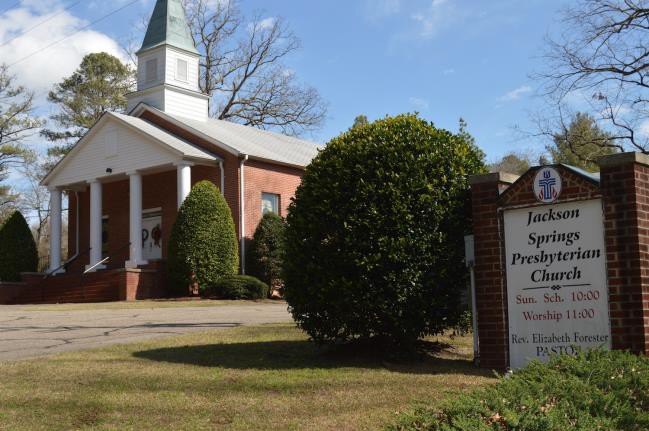
Jackson Springs Presbyterian Church. By Steve Mcrae.
This year our tour was in a part of the Scottish settlements we have not visited before. In the 18th century and well into the 19th, Scots settled in the Cape Fear basin and all across the Sandhills, establishing Presbyterian churches where they could. We began our tour at one of these churches, Jackson Springs Presbyterian, which celebrated its 200th anniversary. After a mineral spring was found near an extensive “Scotch Settlement,” a preaching stand was set up in 1817 to draw the occasional visiting preacher. By 1819 the Rev. John Patterson was their stated preacher, and he officially organized the Mineral Spring Presbyterian Church. In 1889 the name was changed to Jackson Spring.
Their first church was built in 1820 near the present one. Today’s sanctuary was built in 1854. Over the years an extension, balcony, classrooms, a front porch, and a steeple were added. In 1914-1916, the separate doors for men and women were changed to a central door, but men and women continued to sit on separate sides until the 1940s.
Mt. Carmel Presbyterian Church
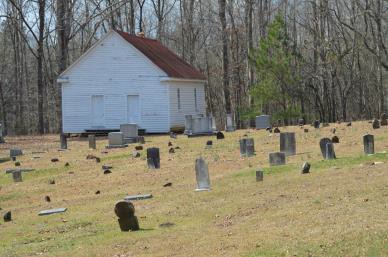
Old frame church building at Mt. Carmel.
The next church we visited was Mt. Carmel (PCA) outside Ellerbe in Richmond Co. This congregation was organized in 1776 by the Rev. John Bethune, who had come to NC with emigrants from the Isle of Skye. Like other recent Scottish immigrants, he sided with the Loyalists during the Revolution, was captured, later released, and went to Canada to found new churches there. A Gaelic-speaking minister named Rev. Colin Lindsay served Mt. Carmel from 1799 to 1812. In 1944 a new brick church was built, but the original frame building has been carefully restored.
Also near Ellerbe is one of our few surviving one-room schools. The Bostick Schoolhouse served children in the region from about 1890 to 1922. It also has been lovingly restored.
Hamlet Presbyterian Church and Railroads
Hamlet Presbyterian Church was organized in 1899 in a small frame building, two years after the town was incorporated. By 1919 membership had increased to 200, and an impressive brick building was completed in 1925.
Friday night we were in Pinehurst for dinner and sleep. Then Saturday we headed south to Hamlet, the hub of three major rail lines. In the early 20th century, more than 30 trains stopped in Hamlet daily, en route to destinations such as New York City, New Orleans, and Florida.
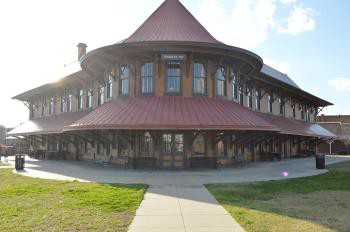
While in Hamlet, we also visited the Queen Anne style Depot, now on the National Register, and the National Railroad Museum, a nonprofit begun by wives of railroad workers in the early days of the Seaboard Airline.
Our last stop was Mark’s Creek church just south of Hamlet, where we had lunch. The church was organized in 1820, but it is believed that a number of church members left to settle in west Florida not long after that. For whatever reason, the church seems to have closed and was reorganized in 1861. A one-room school was nearby in the early 1900s.
Report on the Fall Meeting, Oct. 8, 2016: Graham Presbyterian Church, Alamance County
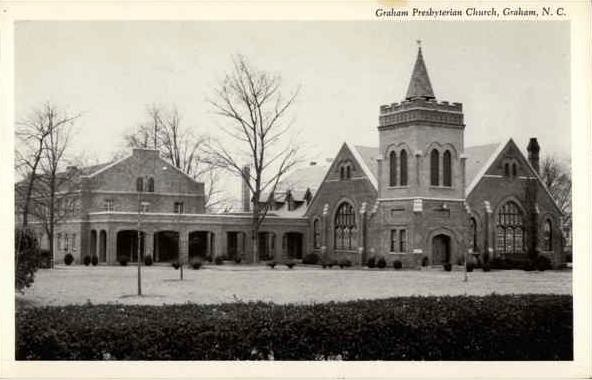
Graham Presbyterian Church, Graham, N. C.
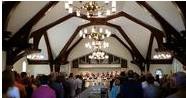
Church interior with 1897 stained glass windows.
In the midst of the pouring rain from Hurricane Matthew, a small group of intrepid members of our society met and were most warmly welcomed at Graham Presbyterian Church. After hot coffee and refreshments, we had a tour of the church, including the beautiful sanctuary with its 1897 stained glass windows. Church members Faye Caynor and Barbara Taylor then told us some of the church’s history. Their published history covers the years 1850 to 1983 and was written by historian Durward T. Stokes of Elon College/University. The town of Graham was established in 1849 as the county seat of Alamance, and by 1850 the Presbyterian Church was formed, meeting at first in the courthouse. Many of its members had previously been members of the Hawfields, Alamance, Bethel, and Crossroads churches. The core of the present church was built in 1855, but it was extensively remodeled and expanded in 1897. The big textile mills in Alamance County were owned by E. M. Holt and his sons, most of whom were members of this church.
When it was time to begin the program on Martin Luther, we found that our speaker, the Rev. Madeline Mercer, had been unable to leave her driveway because of the flooding at Scotia Village in Laurinburg! This is when we first realized that the storm was causing more damage than had been predicted. Carrying on, however, we happily accepted the offer by Dr. Carole Troxler, retired professor of history at Elon, to step up and give us her “Luther lecture.” This turned out to be a most interesting recounting of his early life and the spiritual struggles that led him to challenge the way the church was run in the German states. With the approval of the Church, bankers were selling indulgences in order to recover their loans to the Vatican for the building of St. Peter’s Cathedral. Indulgences were said to lessen the penalty for sins. Such abuses were curbed in the Roman Catholic Church during the Counter-Reformation. In NC we have many Lutheran and German Reformed churches.
Spring Tour of Flat Rock and Henderson County, April 1-2, 2016
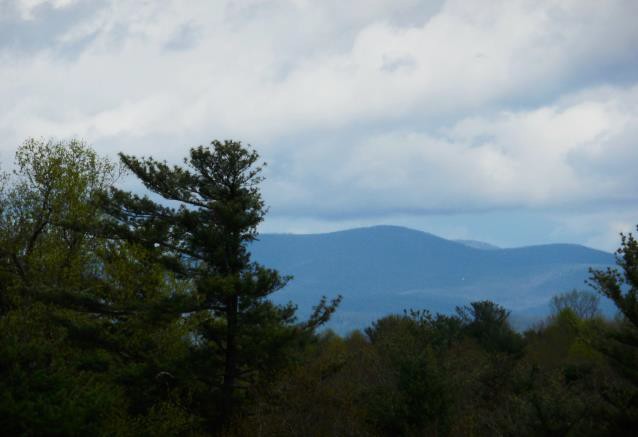
View from Flat Rock.
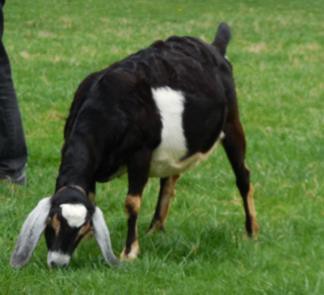
This year’s Spring Tour began on Friday afternoon in Flat Rock at “Connemara”, the former home of the poet Carl Sandburg and his wife. It is now a National Historic Site. The house has spacious rooms and wonderful views of the mountains. Repairs to the house had necessitated the removal and storage of most of the furnishings, but there were large photographs of each room as it had been and will be, and we had a most knowledgeable guide with many stories about the Sandburgs. Afterwards we visited the descendants of their prize-winning herd of goats.
Goats at Connemara.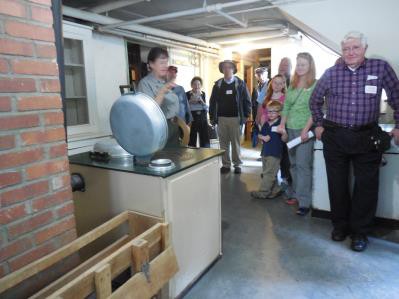
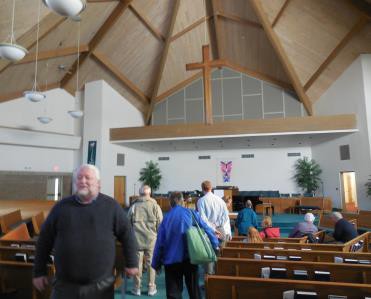
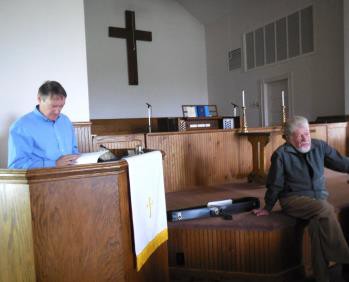
Mills River Presbyterian Church.
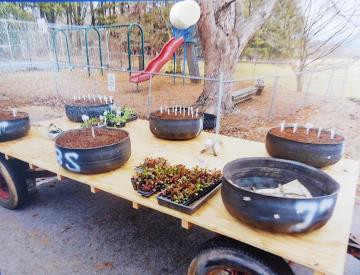
Our next stop was Mills River Presbyterian Church, founded in 1830. We heard about their history of providing the first school in Henderson Co., and about their current educational missions. They provide scholarships to enable all children in their sister congregation in Guatemala to go to school, and have started a garden on wheels, showing local children and adults how to create a tire garden for winter greens and summer vegetables.
Garden on wheels at Mills River.
We then had time to check-in at our motel and have dinner together in a private room at the Golden Corral in Hendersonville.
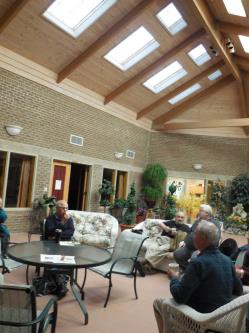
Next morning we left for Trinity Presbyterian in Hendersonville. The congregation was organized in 1965 and has always been very active in the community and in world mission. It grew rapidly, bringing in young families and benefitting from the skills and volunteering interests of many who had retired to the mountains. In 1996 the new sanctuary was completed. Since then they have added a beautiful garden and columbarium, and a glass-roofed atrium where small groups can meet informally.
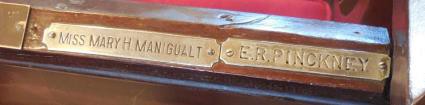
Our next stop was the St. John of the Wilderness Episcopal Church, begun in the 18th century as a private chapel for the Charleston families who spent summers in the mountains. The pews still bear the brass plates with very Charlestonian names such as Pinckney, Manigault, and Grimke, and the cemetery is full of others, including Christopher Memminger, Confederate Secretary of the Treasury. The congregation has recently placed crosses on the unmarked graves in the slave cemetery downhill from the church. Our excellent guide, a member of the church, had many interesting stories from the church’s history.
Slave cemetery at St. John in the Wilderness. Brass nameplates on pews.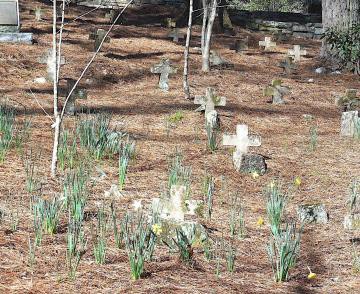
Pinecrest Associate Reformed Presbyterian Church in Flat Rock is the home church of our Membership Chair, Sarah Alexander. Sarah had arranged a very interesting display of photographs, materials, and scrapbooks showing the history of the church. Rev. Chuck Evans, a former pastor there, spoke to us about the church in its beautiful rock-walled sanctuary. He told us about some of the differences between the ARP denomination and the PCUSA, such as the general singing of psalms set to music rather than hymns from non-Biblical sources, though hymns may be used. Also, women may not hold ordained positions. But we are both strongly rooted in the Reformed tradition and have a great deal in common.
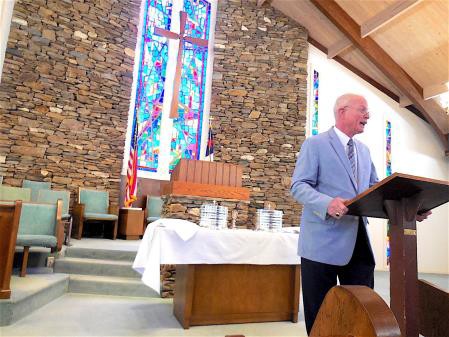
Pinecrest Associate Reformed Presbyterian Church interior.
We ended our time together with a wonderful lunch and a brief business meeting at the Moose Café in Hendersonville – a “Farm to Table” restaurant with great Southern cooking and fresh food from the Farmers’ Market. Meals always begin with hot biscuits and homemade apple butter! They also have restaurants in Asheville and Greensboro. And so we headed home with good memories and a fresh understanding of the past and present life of these churches and communities.