Winter 2016 Newsletter
Spring in “Connemara” and the Blue Ridge Mountains
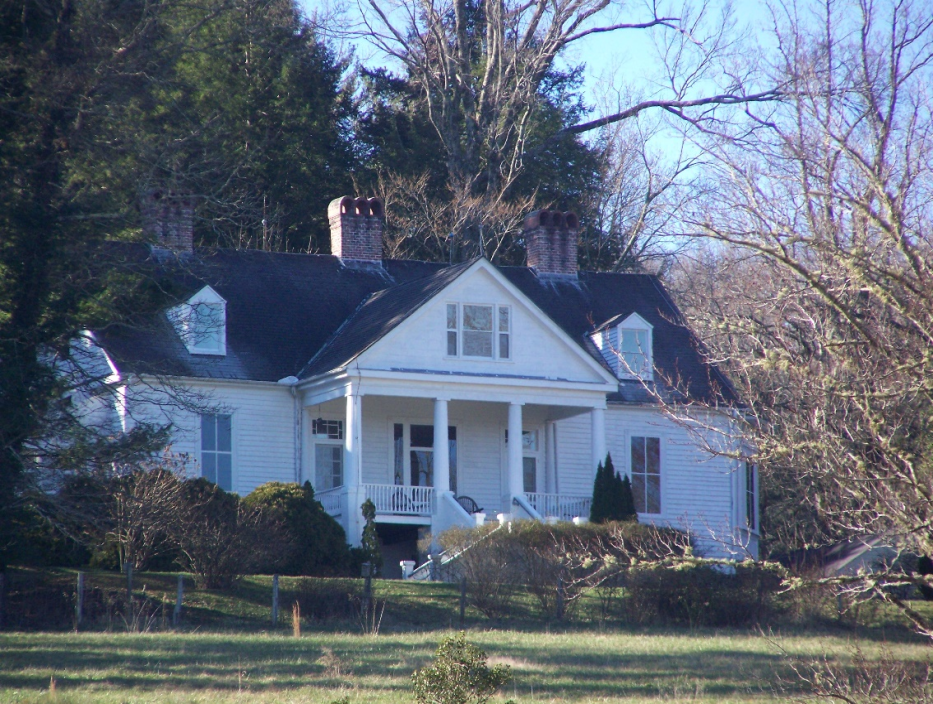
Connemara home of Carl Sandburg. By Sam Martin.
Our Spring Tour for 2016 took us to the Lower Blue Ridge region of southwestern North Carolina, where we explored the stories of those who settled in this area and visited some of their churches and old cemeteries. We were in the PCUSA Presbytery of Western North Carolina and in the Associate Reformed Presbyterian’s Synod of North Carolina.
During the first part of our tour, we explored the Carl Sandburg National Historic Site. Sandburg was a three-time Pulitzer Prize writer, known primarily for his poetry and his six-volume biography of Lincoln, although his collection and singing of American folk songs and his children’s books endeared him to many. He left school at 13, and his youth was filled with manual labor jobs throughout the West. After attending Lombard College and marrying Lillian Steichen, Sandburg became a journalist for the Chicago Daily News. There he wrote many of his best-known poems, including “Fog” and “Chicago.” In 1945 the Sandburgs moved to “Connemara,” where he produced about one-third of his published works and where Lillian (called Paula) developed an award-winning goat herd. The goats are still one of the attractions on the estate.
Mills River Presbyterian Church
Mills River Presbyterian Church was started before 1830 as a small log church in the valley northwest of Hendersonville. Education has always been important to Presbyterians, and in 1830 a two-story building was constructed as the Mills River Academy. School was on the first floor, and the congregation met on the second floor. The academy continued through 1908 and was the first Henderson County school. We visited the cemetery and church and heard a little about the rich history of the area.
Trinity Presbyterian Church
Trinity Presbyterian Church is a more modern structure. We visited the beautiful grounds of the church, the columbarium, and the church itself.
St. John in the Wilderness Episcopal Church

St. John in the Wilderness Episcopal Church.
One of the most historic churches in Henderson County is St. John in the Wilderness Episcopal Church. The church is part of the National Register of Historic Places and was begun as a private chapel by residents of the low country of South Carolina. The chapel burned and another chapel was built of brick in 1833. The chapel was deeded to the Episcopal Diocese of Western North Carolina about three years later. We investigated the history of southern aristocracy and slavery with regards to the church and the area, as well as the prominence of the residents of the community of Flat Rock, the “Little Charleston of the Mountains.”
Pinecrest Associate Reformed Presbyterian Church
The Associate Reformed Presbyterian Church traces its roots beyond the Church of Scotland to the earlier Covenanters. In Flat Rock we visited Pinecrest Associate Reformed Presbyterian Church, and learned more about its history in N.C.
The Associate Reformed Presbyterian Church
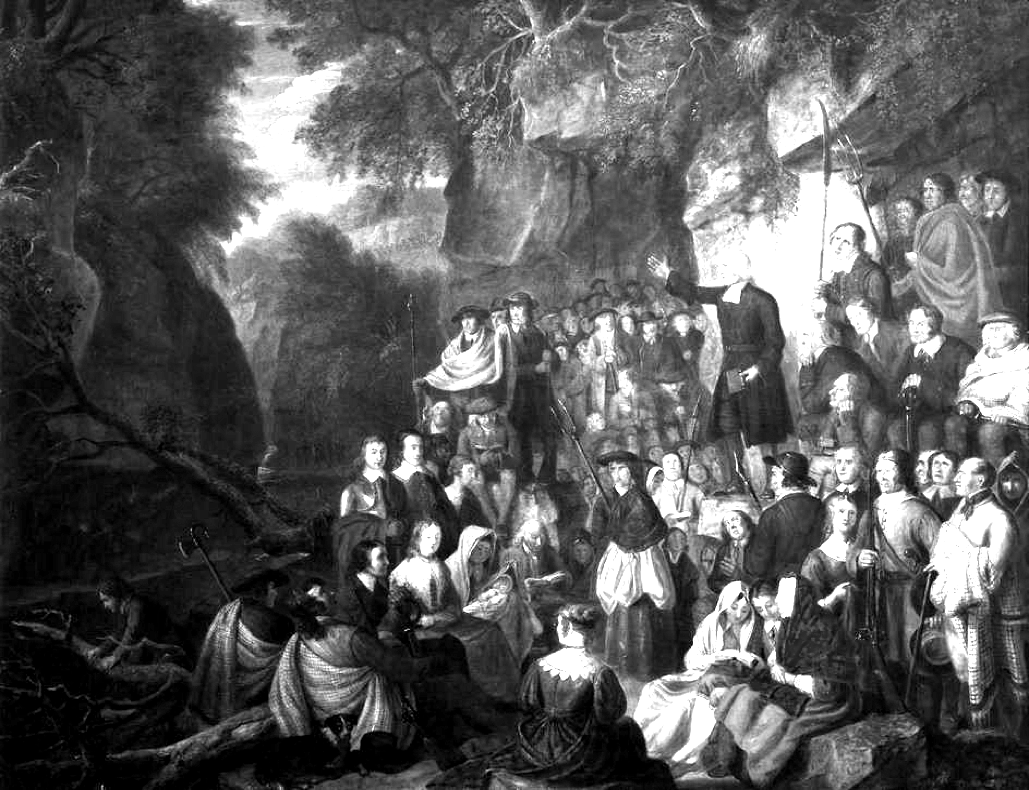
Covenanters in a Glen, painting by Alexander Carse, showing an illegal conventicle, 1680s.
The history of the Associate Reformed branch of Presbyterianism requires a look back at the history of all Presbyterians whose roots are in post-Reformation Scotland. Threatened by both the Roman Catholics and the established Church of England, protestants in Scotland bound themselves together by covenant to maintain the Presbyterian doctrine and policy as the sole religion in their nation. Armies were raised supporting the English Parliament against Charles I and were sent to protect protestants in northern Ireland from Catholic uprisings. The civil war within Scotland (1644-47) between Presbyterians, Episcopalians, and Catholics was bitter. During this turmoil the Westminster Confession of Faith was written, and it was ratified by the Scottish Parliament in 1649. Before long the Covenanters also fought Cromwell’s Puritans. The Restoration of Charles II brought severe persecution of Scottish Presbyterians, including the banning of religious assemblies that were not Church of England. Many met anyway in secret in the hills.
In 1690, after William and Mary had succeeded to the throne, the various Presbyterian congregations became the established Church of Scotland. Although freedom from the episcopal Church of England was welcomed, the close alliance of the Presbyterian Church and the State continued to cause controversy and dissension. In 1733 a pastor by the name of Ebenezer Erskine led a group of Christians known as Seceders in forming a separate Associate Presbytery. Ten years later churches closely allied to the Covenanter tradition of the 17th century organized themselves into the Reformed Presbytery. Members of both groups migrated to Northern Ireland and thence to Pennsylvania, where both presbyteries were organized before the American Revolution.
In 1782 most of the churches in these presbyteries united into the Associate Reformed Synod, with congregations before long in Pennsylvania, New York, Ohio, North and South Carolina, and Georgia. By 1803 there were four Synods and one General Synod. However, the Synod of the West left in 1823, and in 1858 the northern part of the church and many separate Seceder congregations joined to form the United Presbyterian Church in North America, leaving only the Synod of the South as the Associate Reformed Presbyterian Church. Today there are ARP churches in 21 states and in three provinces of Canada. Erskine College and Seminary are in Due West, South Carolina. Their conference center is Bonclarken (“clear clear vision”) in Flat Rock, NC.
The ARP Church remains close to its Covenanter roots. Its doctrine is based on the Bible, “infallible in all that it teaches and inerrant in the original manuscripts,” and on the Westminster Confession and the Catechisms Larger and Shorter. Psalms arranged in meter are generally sung in church, but a church session may allow hymns as well. Women may be deacons, but not ordained ministers or elders. The denomination is part of the North American Presbyterian and Reformed Council and the World Reformed Fellowship.
Doing Research: The Internet Archive
The Internet Archive (https://archive.org) is an excellent source for anyone researching Presbyterian (or other) church history. It contains an enormous number of out-of-print items, including many histories of individual churches; minutes of church sessions, presbyteries, and synod; and copies of the Presbyterian Standard – all completely searchable.
To begin your search, click on “eBooks and Texts”, and then on “American Libraries”. On the right you can enter “North Carolina Presbyterian” to bring up all on that topic, or add the word “history” to bring up all the church histories. You can also search at the American Libraries level for the name of a particular church. Be sure to use quotation marks to keep names of churches or persons together. The initial search is of the cataloging terms and shows all works found; open the book to search within it. A line at the bottom shows the references found. Google may also find one of these books, but often with too many other hits.
There are so many searches you can do on this site, through American and Canadian libraries. It is truly amazing how much material has been digitized and made available on the internet.
First Presbyterian Church, Raleigh: 200th Anniversary
First Presbyterian Church of Raleigh was organized on January 21, 1816, with forty members and Dr. William McPheeters, pastor. At first they met in the original State House on Capitol Square. In 1818 a brick colonial-style church was constructed on the southwest corner facing the square. When the capitol building burned in 1831, the North Carolina Supreme Court met in the church’s Session House until the current capitol building was completed in 1840. The church’s present sanctuary was built in 1900 on the same site as the former.
In the 20th century First Church “mothered” nine churches to serve the growing population of Wake County and one in Johnston County. The church itself, however, has remained downtown. Its church property has expanded, been renovated, and put to good use by the community as well as the congregation. Today it supports many organizations that serve the community.
On Thursday evening, January 21, 2016, the congregation marked its 200th anniversary. The commemoration began in the 1840 State Capitol building with a worship service of praise and thanksgiving led by senior pastor, Dr. Ed McLeod, Jr., and others. Bagpiper Emily Sprague then led the procession of worshippers from the capitol building across the square to the church sanctuary. There the worship and festivities concluded with refreshments. Members of the church had worked with the pastors to plan and carry out the events.
On Sunday the celebration continued during worship with a work composed for the occasion by Dr. Richard Nance of Lakewood, Washington. “Benedicite” (Bless Ye the Lord) was performed by the chancel choir and guest instrumentalists.
Throughout the year there were special guest preachers and concerts. Down a long hallway in the church, its history is now detailed in word and picture. Special displays featured families with generations of members. Oral histories were recorded onto DVDs. Dr Glenn Jonas of Campbell University wrote a new history of the church released in September. And each member or family was challenged to put in 200 hours of service in the community and record them in displays at the church.
By Sally MacLeod Owen
Report on the Fall Meeting, 2015: Summerville Presbyterian Church, Harnett County
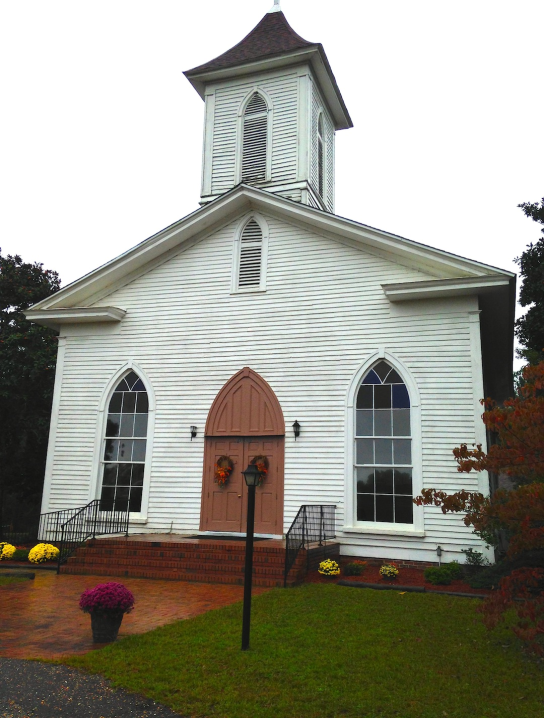
Summerville Presbyterian Church.
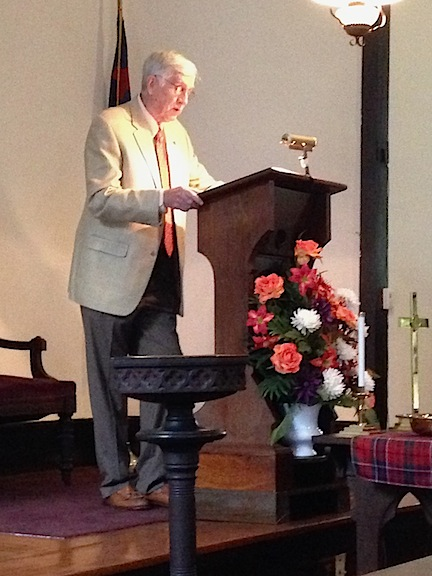
Rev. Tom Spence speaking.
On October 10 our Fall Meeting was held at the historic Summerville Church outside Lillington. Rev. Tom Spence, long-time member and former officer of our society, is the interim pastor there, and he spoke to us about its history. The area was in the northern part of the original Cumberland County, and as waves of Scottish immigrants continued to arrive well into the 19th century, they were forced to find land farther upriver, beyond the rapids, a long way from Fayetteville. The Presbyterian church at Barbecue was 20 miles away, so a church was built of logs with river stones for its foundations. It was organized in 1811 and named Tirzah, a pleasant place. One of its founders, Neill McKay, had a large plantation nearby, and some local slaves became communing members. McKay’s son Neill became a prominent Presbyterian minister, serving in the area for almost 50 years, establishing the Summerville Academy, and serving on the board of trustees for UNC. In 1845 he built a new plantation house named Summer Villa.
When lightning destroyed the first church building, the present sanctuary was built in 1849 and the congregation’s name was changed to Summerville. In the 1870s the appearance of the church was changed from Greek Revival to Gothic, but the walls, pulpit, table, and font are original, and the pews date from the 1870s. The large cemetery served the town as well. It contains the grave of a stranger who died on the church steps. The building has not been locked since. When Harnett County separated from Cumberland in 1855, the courthouse was to be near the church in a new town named Toomer, after a Fayetteville lawyer. Not happy with location or name, the residents voted to put the county seat two miles away in a new town on the Cape Fear River, named Lillington. Eventually the church was dissolved, but it was reorganized in 1951. The building is on the National Register of Historic Places, and in recognition of its Scottish roots, the congregation has its very own tartan!
Historic Preservation and the National Register
Historic preservation presentation: Do not sandblast buildings. In masonry construction, it will destroy the hard outer surface of the brick as well as the tooled protective mortar joint making both the brick and the mortar joint more permeable and increasing moisture infiltration.
The program for the meeting was very fitting. Jessica Dockery and Jeff Adolphsen from the State Historic Preservation Office spoke to us about the National Register, what its criteria are, and what are the standards for repairing and rehabilitating an older building. There are over 2700 North Carolina properties and historic districts listed on the National Register at the present time, including 54 Presbyterian and A.R.P. churches and Flora McDonald College. Forty-one of the Presbyterian sites have been visited by NCPHS one or more times in the past 50 years.
And yet, many of our very historic churches are not on this list. Why is that??
- Sometimes changes made to the original church disqualify it. The majority of the historical building must be there, with no large additions in front. It must look basically the same. It must also have architectural, cultural, or historical significance.
- Because of budget cuts, the State Historic Preservation Office no longer seeks out properties to be nominated and does not prepare the nominations. A building or site may come to their attention through a survey of historic properties in an area, or it might be put forward by individuals.
- The process takes a long time. A property that has not been previously surveyed must apply to be studied, and if studied, it may or may not be approved for the next step – a detailed, scholarly, rigorously verified and illustrated description and history of the property. This nomination is then submitted by the State Preservation Office to the National Register Advisory Committee for review and a final decision.
- Documentation and nomination are likely to be expensive. The state office does not charge for its advice, but the research and preparation of the paperwork according to strict guidelines may require hiring a consultant whose charges could add up to around $6,000.
- Since churches do not pay taxes, they do not benefit from the state and federal tax credits. Being listed on the National Register is mainly for the honor of the thing.
Once on the list, are there any restrictions or protections?
- The National Register does not control what you do to the property, but the state or municipality may impose restrictions. A listed building can be torn down, but any tax credits would have to be repaid. It can be sold, with a covenant for its maintenance.
- Listing provides limited legal protection, but only from development that requires federal permits. It does make a clear statement that this property is an important one to preserve.
Once listed, are there guidelines for preservation, maintenance, and repair?
Yes. The Secretary of the Interior’s illustrated standards and guidelines for the rehabilitation of historic buildings may be found deep in the National Park Service website at http://www.nps.gov/tps/standards/rehabilitation/rehabilitation-guidelines.pdf. These must be followed if the cost is to be partially reimbursed by tax credits, but should be followed if at all possible when caring for any historic building.
For other questions about historic preservation, go to their website, www.hpo.ncdcr.gov.
“Fog” by Carl Sandburg
The fog comes on little cat feet.
It sits looking over harbor and city on silent haunches and then moves on.
Carl Sandburg.