Winter 2015 Newsletter
Exploring Colonial North Carolina – Edenton
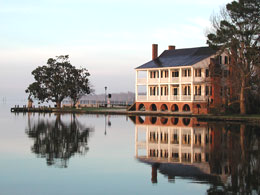
Penelope Barker House, ca. 1782. From NCpedia.org.
The Spring Tour for 2015 brought the North Carolina Presbyterian Historical Society to the tidewater region of the Albemarle Sound and northeastern North Carolina in New Hope Presbytery. This area is rich in beauty and history—but not in Presbyterians! What was colonial religion like where the Church of England was dominant?
The tour began with our gathering on the waterfront in the beautiful town of Edenton. The Penelope Barker House is home to the Edenton Historical Commission and its visitors’ center.
Edenton was founded in 1712 and incorporated in 1722 as the first colonial capital of North Carolina. Located at the head of Albemarle Sound, Edenton is the second oldest town in North Carolina (Bath being the oldest), and served as a center of trade with the other colonies and trade routes prior to the Revolution. Edenton sported many brick houses and one of the finest brick public courthouses in the fledgling colonies.
Edenton is considered one of the most beautiful small towns in America. We visited the newest resident of the waterfront, the restored Roanoke River lighthouse. Built in 1886 at the mouth of the Roanoke River, it was decommissioned in 1941, became a private residence, and fell into disrepair. In 2007 the original structure was moved by barge to the Edenton waterfront. Lovingly restored, it was opened to the public in the summer of 2014.
The Historic Edenton State Historic Site is located a few blocks north of downtown. It is located in a pink house that once was the home of the slave later known as Harriet Jacobs. She was born in Edenton in 1813 and escaped by sea in 1842, Edenton being part of the maritime underground railroad. Under a pseudonym she wrote her autobiography, Incidents in the Life of a Slave Girl (published in 1861), which described many of the same scenes we will see.
We toured other properties under the auspices of the Historic Edenton State Historic Site, including St. Paul’s Church, the Cupola House, the James Iredell House, and the Chowan County Courthouse (1767).
In 1700 the Church of England became the established church in North Carolina. The parish of St. Paul’s was organized in Edenton the next year, and the complete set of vestry minutes has survived, beginning in 1701. These tell a great deal about religion and local government in colonial NC, as members of the vestry were elected and were responsible for the poor as well as the church. The churchyard was begun in 1722, and many notable citizens of the colony were buried there. Many of the 700 graves are not marked, however. The church building was not begun until 1736 and took over 40 years to complete. It is the second oldest church in North Carolina, after St. Thomas’s in Bath.
In 1712 the colonial Assembly authorized a town to be laid out on Queen Anne’s Creek and the building of a courthouse in which they could meet. The present courthouse was built in 1767 and is the third on the site. It is the finest Georgian courthouse in the South. Edenton was incorporated in 1722 and named for Gov. Charles Eden, who had just died.
The Cupola House is an architectural gem, built in 1758 for the Earl of Granville’s agent, Francis Corbin. Its colonial gardens are beautiful in April.
James Iredell’s house was begun in 1776 and expanded about 1816. He was one of the original justices on the Supreme Court, appointed by President Washington and serving from 1790 to 1799. His son was born in this house and served as governor of North Carolina from 1827 to 1828.
In contrast to St. Paul’s Episcopal, Edenton’s First Presbyterian Church was founded in 1905 by Albemarle Presbytery and is the only Presbyterian church in Chowan County. The beautiful and modern brick church is located at 200 Moseley Street.
The Edenton Tea Party
On October 25, 1774, many ladies of Edenton met to express their support for the growing protest against taxation without representation. In the process, they participated in one of the first organized women’s political actions in the history of our nation. The meeting was led by Penelope Barker and held at the home of Elizabeth King, where 51 women signed an agreement to give up newly taxed British tea and other goods, in support of resolves passed by the First Provincial Congress in New Bern two months earlier.
Several of the lesser-known “Founding Fathers” were residents of Edenton. Such notables as Joseph Hewes (member of the Continental Congress and signer of the Declaration of Independence), Samuel Johnston (governor and first U.S. Senator from North Carolina), and Hugh Williamson (physician and signer of the U.S. Constitution) were one-time citizens of Edenton.
Recent discoveries related to The Lost Colony have revealed in the general area of Edenton in present day Bertie County. Perhaps members of the Sir Walter Raleigh party or the Ralph Lane colony walked the same ground that we covered during our visit.
By Sam Martin.
Summerville Presbyterian Church
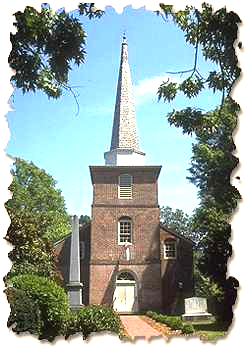
This fall our society met at the historic Summerville Presbyterian Church in Harnett County. Organized as Tirzah Presbyterian in 1811, the church served the growing numbers of Scottish immigrants, many of whom are buried in its large cemetery. The Summer Villa plantation nearby was the home of one of its early pastors, Neill McKay. The congregation still meets in the perfectly preserved 1849 sanctuary, which is on the National Register of Historic Places.
PHC Symposium: Great Awakenings
The 2015 North American Symposium at the Presbyterian Heritage Center in Montreat was “Great Awakenings: Evangelists and Their Impact on Culture,” held on Friday and Saturday, May 29-30, 2015. The conference was a broad survey of evangelism in America, from the colonial revivals sparked by George Whitefield and Jonathan Edwards, through the nineteenth century frontier revivals and the influence of leaders such as Charles G. Finney and Dwight L. Moody, to more recent figures such as Billy Sunday, Billy Graham, and a host of others. Topics included evangelists at Montreat, and the influence of women such as Fanny Crosby on American evangelicalism.
Preservation of Records and Artifacts
The State Archives of North Carolina has begun a Traveling Archivist Program, primarily to assist small institutions that have records and/or artifacts that relate to NC history and culture, but have limited resources to care for them. The archivist surveys the collection and advises on preservation of the materials, providing better access, security, etc.
A Great Historical Resource On-Line
Among the many resources available on-line for researching congregational or personal history is one that is often overlooked – Google Books, which can be accessed by simply entering “Google books” in the search engine. Enter a word or phrase in the initial Search box, and Google will instantly search for it in all the millions of books and periodicals that they have digitized, and will present you with a list of works that contain that word or phrase. Clicking on a book will usually bring you to the pages where the word or phrase is found. Sometimes only snippets of the book can be read, but more often the book can be browsed for the full context of the reference. If a book containing it cannot be read at all on-line, information about the book is given, including the number of pages that contain that term.
For example, a search for the term “Henry Pattillo” will list first a reprint of his Geographical Catechism, which is fully readable on-line, and then his Sermons, printed in 1788, which is not. Entry of the name in that spelling and in the other standard spelling, “Henry Patillo,” will bring up many more references to him in a great variety of older and more recent works, including an interesting description of him at the age of 74, printed in the Connecticut Evangelical Magazine of Dec. 1800.
If one of the books is a free ebook, you can click on the word “Read” that appears after the date of the book. That will bring you to the beginning of the book rather than a page on which your reference appears. You can then scroll down the pages on-line, or, by clicking the tools symbol in the upper right-hand corner, you can download the book in PDF.
To go to a book directly, enter “Google books advanced search” into your search engine. On that page you can choose “Full view only” and can search by title, author, etc.
Among the myriad of books that are fully searchable are printed histories of the Presbyterian Church; printed records such as General Assembly minutes; many individual church histories; the Dictionary of North Carolina Biography; county histories; will abstracts; genealogical works, etc. Enter the name of your church, and you are likely to find a surprising variety of references.
Notes on our 50th Annual Meeting
This very special meeting took place in the very Presbyterian county of Mecklenburg, at the lovely church called Ramah. We really enjoyed touring the church and its extensive cemetery, as well as its large 1930s log hut used for Bible classes, social functions, and scouts.
The most important part of the meeting, however, was the program – a long and free-wheeling discussion of the North Carolina Presbyterian Historical Society, its past and its future. Our brainstorming resulted in many suggestions for outreach and events:
- Develop programs about Presbyterian history that could be given at Presbyterian and other retirement homes.
- Many churches have fellowship groups for older adults, who might also be interested in a program about some aspect of Presbyterian history or simply information about our society and upcoming events. There are also adult study groups such as the Questers, which is active in Sanford.
- At the presbytery level, we could present about the importance of Presbyterian history to the meetings of Presbyterian Women, who are writing about their history every year, and perhaps at staff development workshops.
- We should do more to involve Presbyterian colleges in the state and their historians – for example, a tour including Johnson C. Smith, Queens, and Union Presbyterian Seminary in Charlotte. A program about Presbyterian history relating to higher education might interesting for the Presbyterian Student Centers.
- We should work more closely with the Presbyterian Heritage Center in Montreat, especially to develop workshops on writing a church history. We should also publicize what they are doing and help them build resources.
- We should include more about the history of African-American Presbyterians in our state, and about their churches and colleges. McClintock Presbyterian Church in Charlotte will be celebrating its 150th anniversary and is looking for both information about the church and ideas for the celebration.
- If possible, we should find out about upcoming church celebrations and let people know about them – perhaps through emails to our members and also via our website. But how to find out about these in a timely way?
- We should reach out to the Associate Reformed Presbyterians about our meetings.
- We need to settle on the dates of meetings and tours a year or two ahead of time, so they can be on everyone’s calendar. Suggestions for future tours included the Nutbush/Grassy Creek area, the area around Ashpole, colleges in Charlotte, and possibly a tour of churches in South Carolina.
- We could schedule occasional events outside the usual spring and fall meetings, such as a summer trip to Kings Mountain for the play “Liberty Mountain” by Bob Inman.
- Finally, we must re-do our website to make updating it easier, to make space for more photos, to allow for church anniversaries and events to be posted, and to provide information and references for Presbyterian history in North Carolina.