Summer 2015 Newsletter
Summerville Presbyterian Church and the Problems of Preserving Historic Churches
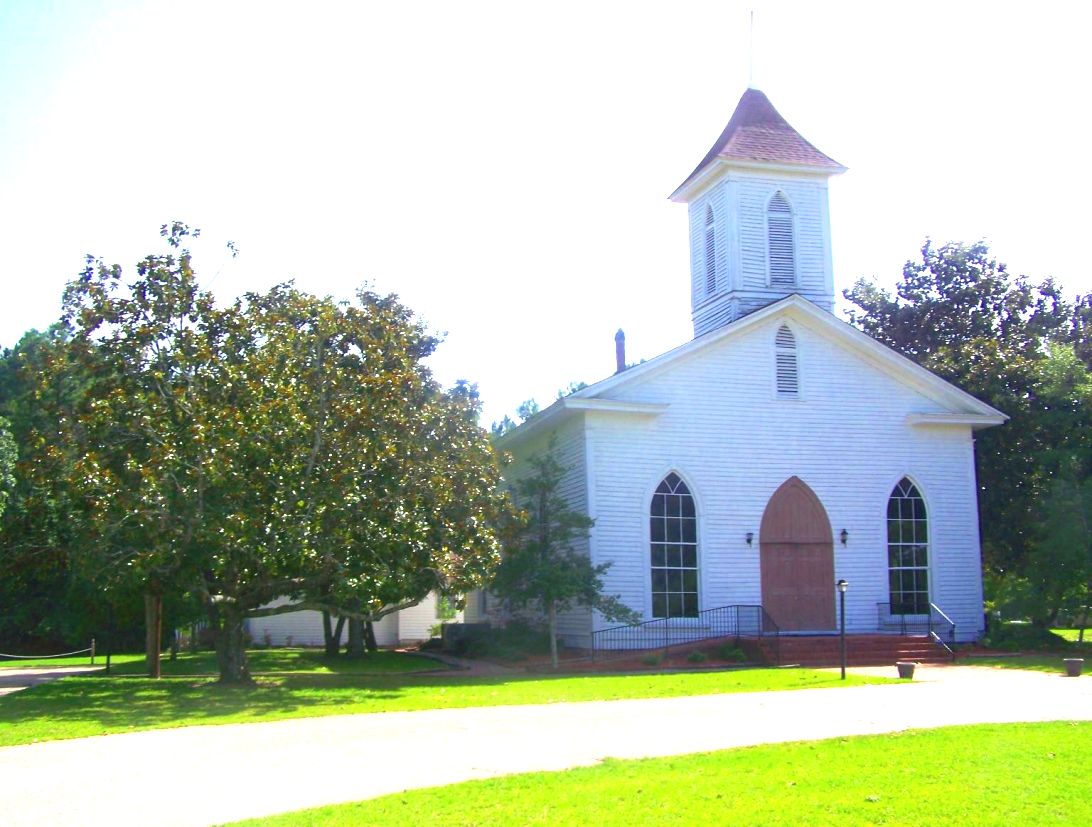
Summerville Presbyterian Church, Lillington.
The Summerville Presbyterian Church is located near Lillington in the heart of North Carolina in Harnett County. The church was established in 1811 as Tirzah, the first daughter of Barbecue Presbyterian Church. The church building and cemetery were included on the National Register of Historic Places in 1985.
The community of Summerville and the Summerville Presbyterian Church have intriguing histories that predate the establishment of Harnett County. From colonial days onward, the population of the upper Cape Fear region grew steadily, due to the commercial importance of the river for trade and agriculture. The good citizens of northern Cumberland County wanted a more convenient location to do their political business, and for over 100 years had tried several times to get the colonial government and General Assembly to agree to their wishes. When Harnett County was finally established in 1855, the center of the new county, already the home of the highly regarded Summerville Male and Female Seminary, was selected to be the county seat.
However, two facts seemed to doom this decision. First, the legislature named the new town Toomer, for Fayetteville Judge J. D. Toomer (1784-1856). A common comment was “we didn’t fight for separation from Cumberland County so we could live in a town named for a Fayetteville lawyer!” The second fact was the location an inconvenient walk of about three miles from the river and its crossing point.
The courts continued to be held at Toomer for about five years until the citizens voted to move the county seat closer to the river, establishing a new town named for war hero Alexander Lillington. An interesting story concerns the arrest of the first prisoner placed in the brand new jail. The man escaped before breakfast of the first day by digging through the poorly constructed brick walls after “regaining his sobriety.” All prisoners were kept from that point forward in Fayetteville until the new courthouse in Lillington was completed.
The Summerville Presbyterian Church building is an antebellum structure constructed in 1848. It is the oldest church building in Harnett County. It is thought that the original structure took the Greek Revival style popular in many similar rural church structures of the mid-nineteenth century, but changes to the building in the 1870s gave a Gothic Revival look to the exterior. The interior changed little until the 1950s when the gallery below the balcony was enclosed. The pulpit and sanctuary furniture are original, and the pews date to the 1870s.
The church itself was dissolved by Fayetteville Presbytery in 1929, only to be re-established as Summerville Church with 50 members over twenty years later. The fellowship building was built in the early 1950s after the reorganization of the church.
The Summerville Presbyterian Church is also known for being “The Home of the Stranger.”
The National Register of Historic Places
Summerville Presbyterian Church is one of 53 Presbyterian churches in North Carolina that have been placed on the “National Register.” What is it, and what difference does it make to the congregation? What are the tangible benefits, aside from the honor? And does it in any way limit what the congregation can do? Why are some of the more historic churches NOT on the register?
Here are the Presbyterian churches on the National Register in North Carolina, by county:
- Alamance: Cross Roads Presbyterian Church and Cemetery and the Stainback Store, Cross Roads Hawfields Presbyterian Church, Mebane
- Avery: Crossnore Presbyterian, Crossnore
- Bladen: Brown Marsh Presbyterian, Clarkton Mount Horeb Presbyterian Church and Cemetery, Council South River Presbyterian, Garland
- Brunswick: New Hope Presbyterian Church, Winnabow
- Burke: Waldensian Presbyterian Church, Valdese
- Cabarrus: Rocky River Presbyterian Church, Rocky River
- Caswell: Griers Presbyterian Church and Cemetery, Frogsboro vicinity Red House Presbyterian, Semora
- Catawba: First Presbyterian, Hickory
- Chatham: Pittsboro Presbyterian, Pittsboro
- Cleveland: Shiloh Presbyterian Church Cemetery, Grover
- Craven: Ebenezer Presbyterian, New Bern First Presbyterian Church and Churchyard, New Bern
- Cumberland: Big Rockfish Presbyterian, Hope Mills First Presbyterian, Fayetteville Old Bluff Presbyterian, Wade
- Duplin: Hebron Presbyterian, Pink Hill
- Forsyth: Lloyd Presbyterian, Winston-Salem
- Guilford: Buffalo Presbyterian Church and Cemetery, Greensboro
- Harnett: Summerville Presbyterian Church and Cemetery, Lillington
- Iredell: Bethany Presbyterian Church and Cemetery / Ebenezer Academy, Statesville Bethesda Presbyterian Church, Session House, and Cemetery, Amity Hill Centre Presbyterian Church, Session House, and Cemeteries, Mount Mourne Coddle Creek Associate Reformed Presbyterian Church and Cemetery, Rocky River
- Lee: Buffalo Presbyterian Church and Cemeteries, Sanford
- Euphronia Presbyterian Church and Cemetery, White Hill
- Lenoir: Kinston Baptist/White Rock Presbyterian Church, Kinston LaGrange Presbyterian Church, LaGrange
- Lincoln: First Presbyterian, Lincolnton
- Macon: First Presbyterian, Highlands Franklin Presbyterian, Franklin
- Madison: Dorland Memorial Presbyterian, Hot Springs
- McDowell: First Presbyterian, Marion
- Mecklenburg: East Avenue Tabernacle Associated Reformed Presbyterian, Charlotte First Presbyterian, Charlotte Hopewell Presbyterian Church and Cemetery, Long Creek Township Providence Presbyterian Church and Cemetery, Matthews Ramah Presbyterian Church and Cemetery, Huntersville Steele Creek Presbyterian Church and Cemetery, Charlotte
- Moore: Bethesda Presbyterian, Aberdeen
- Robeson: Ashpole Presbyterian, Rowland Philadelphus Presbyterian, Philadelphus
- Rowan: Back Creek Presbyterian Church and Cemetery, Mt. Ulla Third Creek Presbyterian Church and Cemetery, Cleveland Thyatira Presbyterian Church, Cemetery and Manse, Millbridge
- Sampson: Black River Presbyterian and Ivanhoe Baptist Churches, Ivanhoe Oak Plain Presbyterian Church, Waycross
- Scotland: Laurel Hill Presbyterian, Laurinburg
- Wayne: First Presbyterian Church (Christian Science Church), Goldsboro
- Wilkes: Wilkesboro Presbyterian, Wilkesboro
State Historic Preservation Office
One of the chief tasks of the State Historic Preservation Office is to conduct an ongoing survey of historic buildings and districts within the state of North Carolina. Over the years surveys of historic architecture have been completed and published for over 40 counties and over 30 municipalities. The more recent surveys are available online, and the published ones are listed at their website, www.hpo.ncder.gov. They also prepare the nominations to the National Register of Historic Places, a federal program, and offer some kinds of assistance and advice to owners of historic buildings. All the National Register nominations are available online.
Spring Tour of Edenton, NC (established as a town in 1712)
1769 map of Edenton by C. J. Sauthier.
On a beautiful spring Friday in Edenton, society members and guests met on the veranda of the Penelope Barker House for registration, refreshments, and conversation. The house where Mrs. Barker and 50 other women met to boycott tea and other British goods in 1774 now overlooks the bay and serves as a Visitor’s Center, but it was moved years ago from the center of town and was beautifully restored. In the house is a copy of the 1769 map of Edenton by C. J. Sauthier.
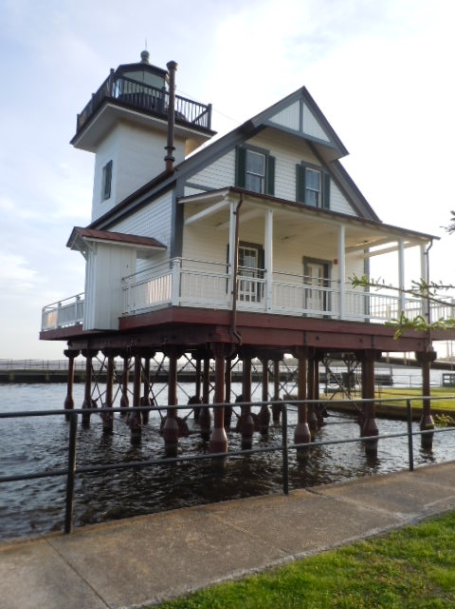
Roanoke River Lighthouse.
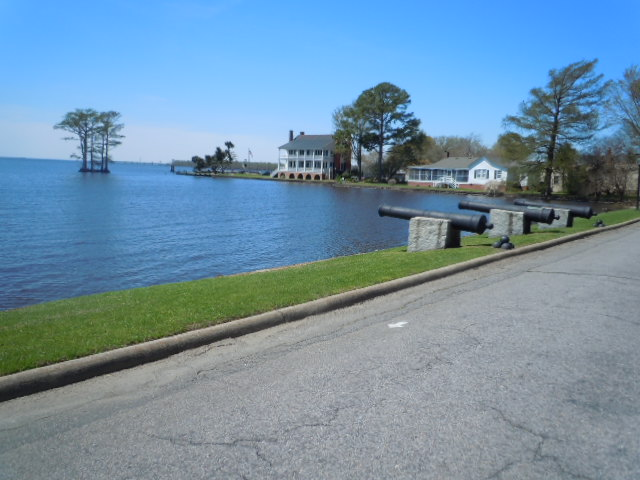
The first stop on our tour was the Roanoke River Lighthouse, which was moved from the river entrance to the bay. It has been restored as it was in the 1880s, as quarters for the lighthouse keeper’s family. A trolley tour followed, taking us all around the town with a very knowledgeable guide telling us much about Edenton history and its residents, including the now disused peanut processing plant and the mill village, and the oldest known house in NC (1719), its original structure recently uncovered in a renovation project.
First Presbyterian Church of Edenton
First Presbyterian Church of Edenton.
Wessington House.
Our next stop was the First Presbyterian Church of Edenton, where we had a long and interesting conversation with members of this small but active congregation. They and the Methodist church have shared hospitality for groups coming to repair storm damage in the area. Their pastor, Dr. G. Douglas Eddy, arranged for a special addition to our schedule – a tour of the Wessington House (1859), being beautifully restored.
The next morning we met for a walking tour at the headquarters of Historic Edenton, housed in the home where Harriet Jacobs was a slave. Her book, Incidents on the Life of a Slave Girl, told of her life in Edenton and her escape to Philadelphia. Our group was divided in two and headed in different directions to see the main historic sites.
St. Paul’s Episcopal Church
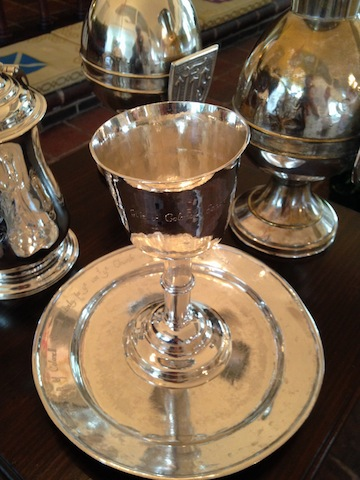
St. Paul’s Episcopal Church communion silver.
St. Paul’s Episcopal Church.
St. Paul’s Episcopal Church (1736). In this lovely colonial church we were treated to a special showing of their communion silver, including a cup and paten given by Edward Moseley, a prominent colonial official and member of the vestry. Other church members included Joseph Hewes, Thomas Jones, James Iredell, and Samuel Johnston. Beginning in the late 19th century, graves and gravestones of early North Carolinians were moved to St. Paul’s churchyard from outlying plantations, for concern about damage from storms. These include Governors Henderson Walker, Thomas Pollock, and Charles Eden, as well as Stephen Cabarrus.
The Cupola House
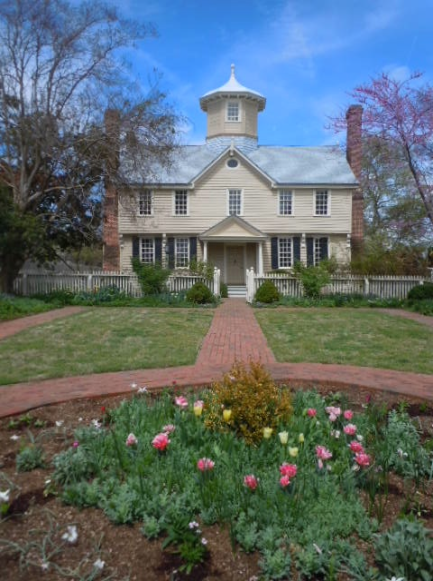
Cupola House.
The Cupola House was built in 1758 by Frances Corbin, land agent for Lord Granville. After the Civil War the house could not be maintained, and in 1918 the elaborate Georgian woodwork was sold to the Brooklyn Museum. This prompted a local association to be formed to purchase the house. The county library for 45 years, the house has now been completely restored with period furnishings, with the lost woodwork faithfully reproduced, and the colonial garden reconstructed.
Chowan County Courthouse
Chowan County Courthouse.
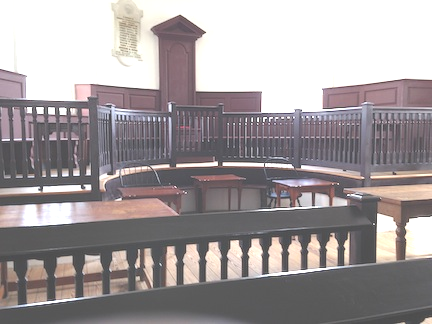
The Chowan County Courthouse, built in 1767, is still in use today and is the most intact colonial courthouse in America. Joseph Hewes helped to raise money for its construction, and Judges James Iredell and Samuel Johnston heard cases in its courtroom. The stocks and pillory are on view behind the building.
The James Iredell House
James Iredell House.
The James Iredell House was built and added to from the 1770s to the 1820s. It was the home of James Iredell, attorney general of NC and associate justice on the first US Supreme Court, and the birthplace of James Iredell Jr., governor of NC, 1827-28, and US senator.